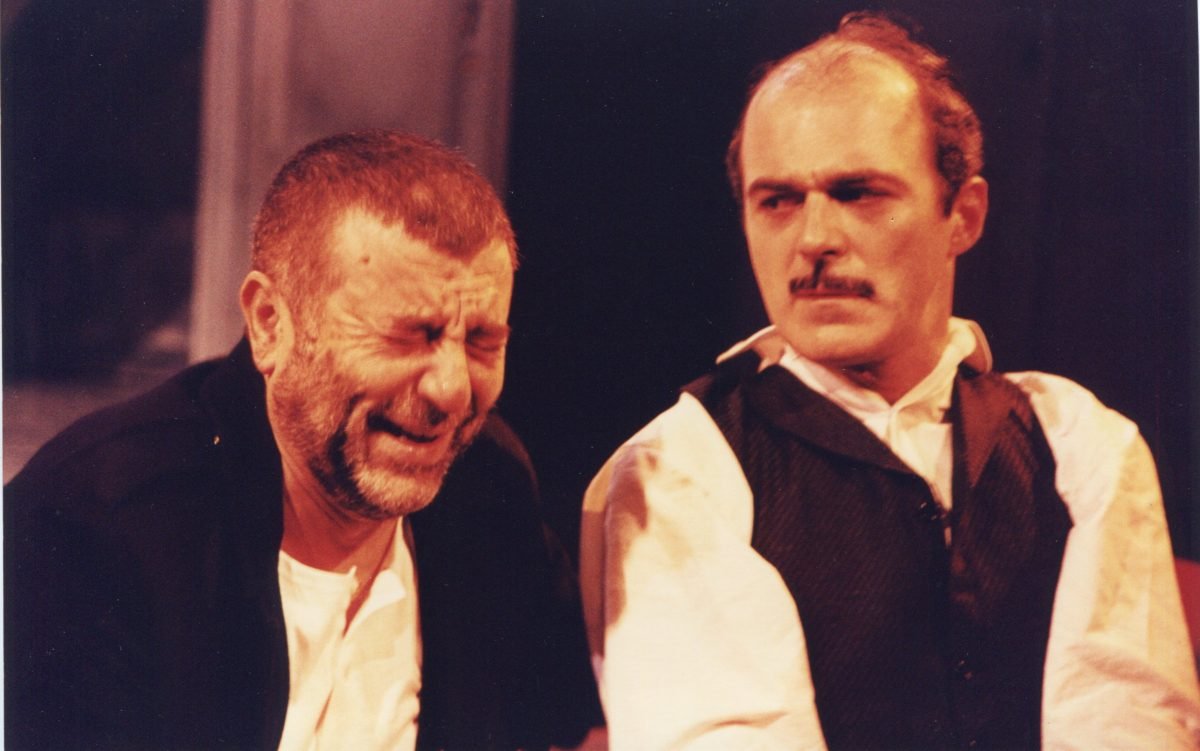
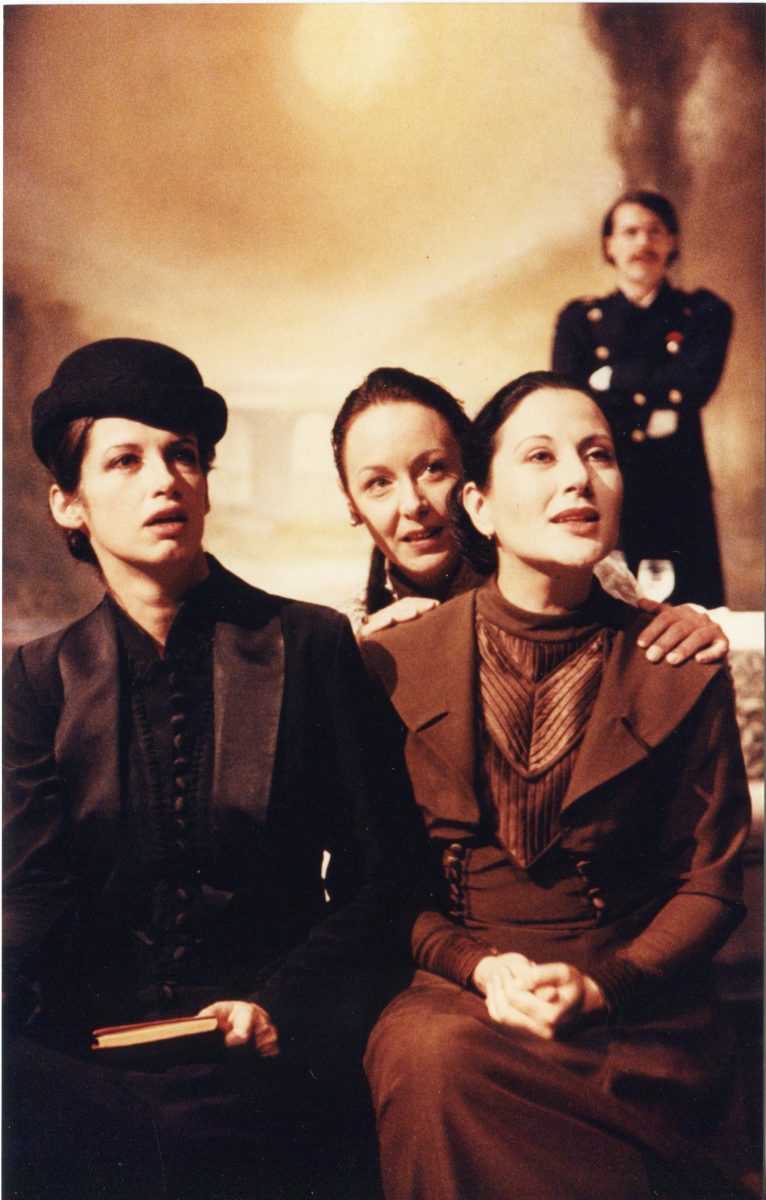
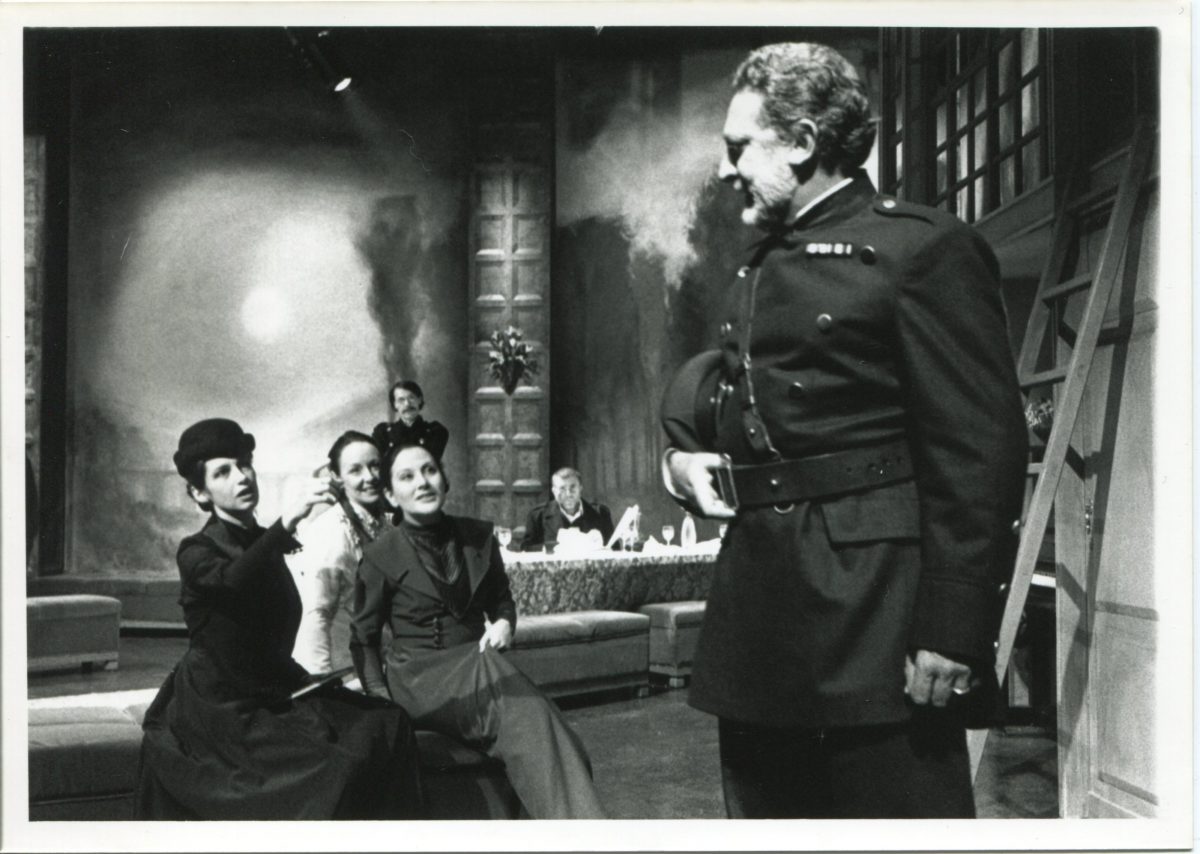

Notos Theatre
First performance: November 2, 1994
Last performance: January 22, 1995
Letter to S. Sokolova
Moscow, 7.9.1901
So, what’s the news? Chekhov is happy. His wife is radiant. These days he is writing a farce, but be careful: it’s a secret. I can imagine how it will turn out… I’m afraid that what will ultimately come out won’t be a farce but a super-tragedy. Even today, he considers Three Sisters a light work…
K. S. Stanislavski
In a few years, the Three Sisters will turn a hundred, and it is certain that they will always be counted among the masterpieces of worldwide theatrical literature. Every artistic creation, once it becomes independent and detached from its creator and immediate surroundings, begins to function autonomously, emitting a greater or lesser radiance — depending on its value. Labels (drama, comedy, tragicomedy), anxieties, pettiness, behind-the-scenes drama, and the details of everyday life gradually recede and disappear, allowing it to travel through time, touching, stirring, or even enraging millions of people.
This translation of the play was commissioned by Notos Theatre of the South and is based on the German translation by Gudrun Düwel, as well as the most authoritative English and French versions of the play. After its completion, a lengthy and extremely meticulous comparison of the text with the original followed. In this new phase of the work, we commented, compared, tested, and juxtaposed every word of the Russian and Greek texts, together with director and actor Stathis Livathinos, who spent endless hours with us, showing genuine and moving interest in the result. Often, he even portrayed various roles in Russian so that we could follow the rhythm and musicality of the phrases. We wholeheartedly thank him for his contribution.
Chekhov’s works have the rigour of a musical score created by a great composer. Any discordance in translation or direction sounds like deafening dissonance. We attempted to speak as each character of the play expresses themselves in their own way, to approach the delicate humour, innuendos, coarse banter, the emotion, and the explosions of the Chekhovian characters, being careful not to betray them. We have the impression that the result is satisfactory. Yannis Houvardas, who was the reason we engaged with the Three Sisters in the first place, made many crucial observations on the final form of the text. Our heartfelt thanks go out to him as well.
A. Isaris – G. Depastas, Athens, June 1994
A. Chekhov, Three Sisters, translated by A. Isaris-G. Depastas, Ypsilon Publishing, June 2005.
Translated by: Alexandros Isaris | Giorgos Depastas
Directed by: Yannis Houvardas (in collaboration with Stathis Livathinos)
Set Design: Thalia Istikopoulou
Costume Design: Yannis Metzikof
Music: Giorgos Koumendakis
Lighting Design: Pavlos Chatzipavlou
Assistant Director: Orfia Sofra
Assistant Set Designer: Vicky Koumbou
Assistant Costume Designer: Katerina Moraitou
Musical Training: Maria Kyriaki
The cast of the play (in the order that the characters are mentioned by the author):
Andrei Sergeyevich Prozorov: Akylas Karazisis
Natalia Ivanovna, his fiancée, later his wife: Natalia Dragoumi
Olga, his sister: Maria Katsiadaki
Masha, his sister: Eleonora Stathopoulou
Irina, his sister: Lydia Fotopoulou
Aleksandr Ignatyevich Vershinin, lieutenant colonel commanding the artillery battery: Alexandros Mylonas
Fyodor Ilyich Kulygin, a high school teacher, Masha’s husband: Stathis Livathinos
Nikolaj Lvovich Tuzenbach, a baron and lieutenant: Lazaros Georgakopoulos
Vassily Vasilyevich Solyony, staff captain: Nikos Hatzopoulos
Ivan Romanovich Chebutykin, army doctor: Giannis Kyriakidis
Alexei Petrovich Fedotik, sub-lieutenant: Thanasis Efthymiadis
Vladimir Karlovich Rode, sub-lieutenant: Michail Rizos
Ferapont, an old door-keeper at the local council: Giorgos Velentzas
Anfisa, an eighty-year-old nurse: Zoi Voudouri
Maid: Marianna Kolovou
Maid: Anna Mailli